Heather
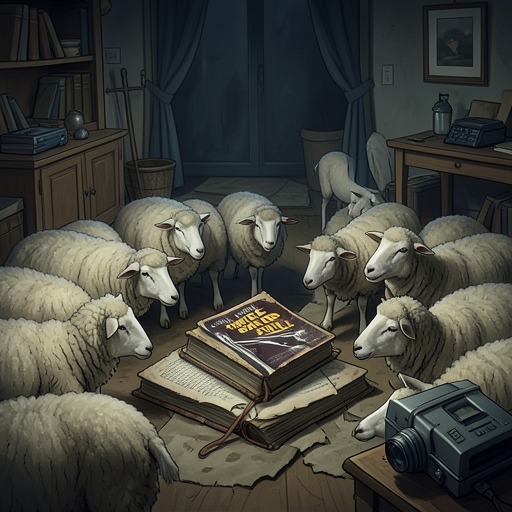
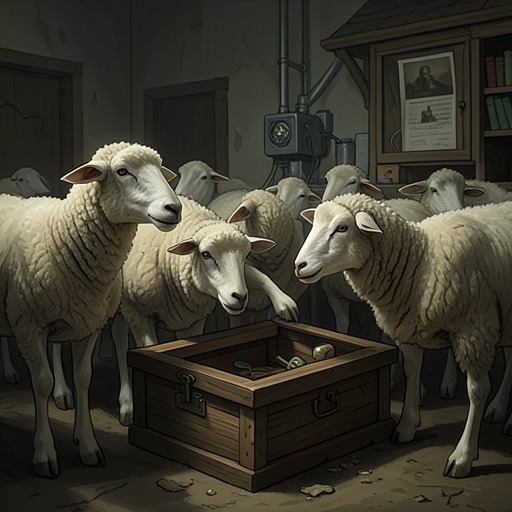
Three Bags FullHeather is a lively young sheep whose habit of speaking before thinking gives the flock both comic disruptions and flashes of unexpected insight. Still little more than a lamb when George Glenn is found dead, she begins with a personal grievance against him, but her place in the flock’s investigation steadily widens: she proposes interpretations, questions accepted explanations, and presses for action. Her confidence is often ahead of her reasoning, yet the novel repeatedly lets that impatience open a path toward truths the more cautious sheep have not named.
Identity and Early Perspective
Heather is introduced as young, energetic, and not always inclined to think before she speaks. Her feelings about George Glenn are initially shaped by a very specific injury to her pride: he docked her beautiful tail at the end of the previous winter, and she still bears him a grudge. That memory colours her early judgment of the shepherd. When the flock discusses what makes a good shepherd, Heather’s grievance belongs beside the wider debate over care, food, and respect; the sheep’s standards are not abstract ideals but measures drawn from their own experiences of human decisions.
Her youth also distinguishes her responses from those of older flock members. She can be defiant, excitable, and quick to seize on a possibility, but she is not simply a source of error or noise. The story makes her eagerness a way of testing ideas in public. Other sheep may qualify a theory or hesitate over its implications; Heather says what the theory would mean if it were true, forcing the flock to confront the gap between an appealing explanation and the facts available to them.
Reading the Mystery
As the sheep try to understand George Glenn’s death, Heather offers a love-story interpretation involving George Glenn, Kate, and Lilly. In her account, George Glenn loves Lilly rather than Kate, while Kate loves George Glenn, and jealousy leads to death. The simplicity delights her: she treats the emotional pattern as immediately legible. Miss Maple, however, points out the mismatch between that proposed motive and the death the flock is investigating. If the rivals were fighting over the person they loved, Miss Maple reasons, Lilly rather than George Glenn would have been the likely victim. She allows that the situation has the scent of a love story, but stresses that Heather’s version does not yet make sense.
The exchange establishes a recurring contrast in Heather’s thinking. She is sharp at recognizing the kind of story an event resembles, but less patient about checking whether every detail fits. Her instinct that love and jealousy matter is not dismissed outright; it remains a provisional reading that must be tested against what the flock learns. Much later, after the sheep’s public reenactment of George Glenn’s death, Heather triumphantly returns to the love-story description. That recurrence gives her early interpretation a complicated vindication: she has sensed an emotional truth in the case, even though her first account of the people and the killing is incomplete.
Heather also contributes to the flock’s efforts to help Sir Ritchfield when his memory begins to fail. The sheep decide to make him a memory so large that it might plug the hole in his recollection, and Heather insists that it must be something no flock has ever done before. The resulting spectacle has the sheep lying on their backs in front of George’s Place, legs raised and bleating. Her proposal turns concern into collective performance: the flock attempts to reach an ailing member not through explanation, but through a striking shared image that might remain with him.
Danger, Leadership, and Self-Control
When Gabriel’s sheep break out of their enclosure and move toward the hay barn, Heather asks what the flock should do. The immediate dispute is practical as well as territorial: Mopple the Whale fears that the newcomers will graze the meadow bare, leaving the resident flock without pasture. Heather’s question marks her as part of the group confronting a new threat, while the others weigh whether to shelter or drive the intruders off. Later, after seeing Gabriel cut grass with George Glenn’s scythe, the sheep witness a human using a tool that destroys grass rather than eating it. The sight makes the danger of Gabriel’s methods concrete, sharpening the conflict beyond a simple contest over grazing.
Heather’s response develops from asking what to do into demanding that something be done. Seeing Gabriel watching the shepherd’s caravan, she says that the flock must get rid of him, and no one contradicts her. The problem is how to act without harming Gabriel’s sheep, whose confinement and plentiful fodder already trouble the flock. When the idea of making those sheep appear ill arises, Heather bitterly asks what could happen to them behind the fence with all the food Gabriel throws to them. Zora immediately objects that they have a hard enough time already. The exchange shows Heather’s forcefulness, but also the ethical limit around it: she wants to resist Gabriel without treating the vulnerable flock as expendable.
Her wish to take control is explicit during Melmoth’s lesson in attention. While the sheep are being taught to watch a stone they believe is not dangerous, Heather loses patience and says she wants to learn to herd sheep as Melmoth does and to become dangerous. Melmoth answers that she cannot herd anyone until she can herd herself; she is already dangerous, but first as a danger to herself. The lesson turns Heather’s ambition back on her own impulsiveness. By the end of the afternoon she has learned to keep quiet, a modest but meaningful change for a sheep whose first instinct is to voice each new thought.
Family, Justice, and the Case Against George Glenn’s Killer
Heather’s mother, Willow, is normally so silent that the flock has treated her quietness as part of her nature. When Willow declares that having Things is bad, Heather lowers her head and addresses her as her mother. The public rebuke is striking precisely because mother ewes are not ordinarily understood to scold their offspring in front of the flock. The moment briefly exposes Heather not as a confident commentator but as a young sheep checked by someone whose judgment carries private authority. Willow’s intervention also complicates Heather’s eagerness to possess or pursue Things: the lesson comes from within her family, not only from the flock’s older leaders.
Her questions about George Glenn’s death remain direct even when the sheep speculate about what the dead might see or why he cannot return. Heather refuses to let the discussion rest at the rule that only the murderer may see George Glenn’s ghost; she asks why the long-nosed man murdered him. The question shifts attention away from the mechanics of haunting and back to motive. Later, when the sheep try to make their explanation of the case understandable to people, Heather states the accusation in its bluntest form: Beth was George Glenn’s murderer, first with poison and then with the spade. The statement is a compressed conclusion, not a full account of the events, but it shows how decisively Heather has moved from proposing possibilities to naming the person she believes responsible.
The wider human conflict around George Glenn also enters the flock’s understanding through what the sheep overhear. Harry the Sinner and Tom speak of suspected drugs, the proposed development of the land, and boats bringing something to the caravan at night. Heather is among the sheep whose knees shake with indignation as they hear George Glenn described as an obstacle and his pasture as wasted on sheep. This scene connects her sense of justice to more than the private circumstances of the death: the flock hears people discuss the land and its possible profit as if George Glenn and the sheep were barriers to be removed.
Change and Narrative Role
Heather’s arc is not a transformation from foolishness into unerring wisdom. She remains quick, emotional, and sometimes premature in her conclusions. What changes is the range of what she is prepared to notice and the seriousness with which she pursues it. A lamb’s resentment over a docked tail gives way to questions about the safety of the flock, the treatment of Gabriel’s sheep, the meaning of George Glenn’s death, and the identity of his killer. Melmoth’s lesson in self-herding offers a small practical counterweight to her desire to become dangerous: Heather learns that attention and restraint are also forms of strength.
Her recurring love-story interpretation gives the novel a further way to measure intuition against proof. At first she insists that George Glenn, Kate, and Lilly form a simple triangle, despite Miss Maple’s objection that the proposed killing does not fit that pattern. Near the end, Heather celebrates the description again, waggling her ears in triumph. The recurrence does not erase the earlier correction; instead, it marks how Heather keeps hold of an interpretation while the flock’s understanding changes around it. She supplies neither the most disciplined investigation nor a detached verdict. Her narrative value lies in the pressure she exerts on the flock’s thinking: she says the emotionally difficult thing aloud, asks again when an answer is insufficient, and helps turn scattered suspicions into an accusation that can be made public.